
Document AI for HubSpot
CloudFiles turns your files into a knowledge graph inside HubSpot, one that doesn't just show the files linked to a record, but proposes the updates and details hiding inside them.
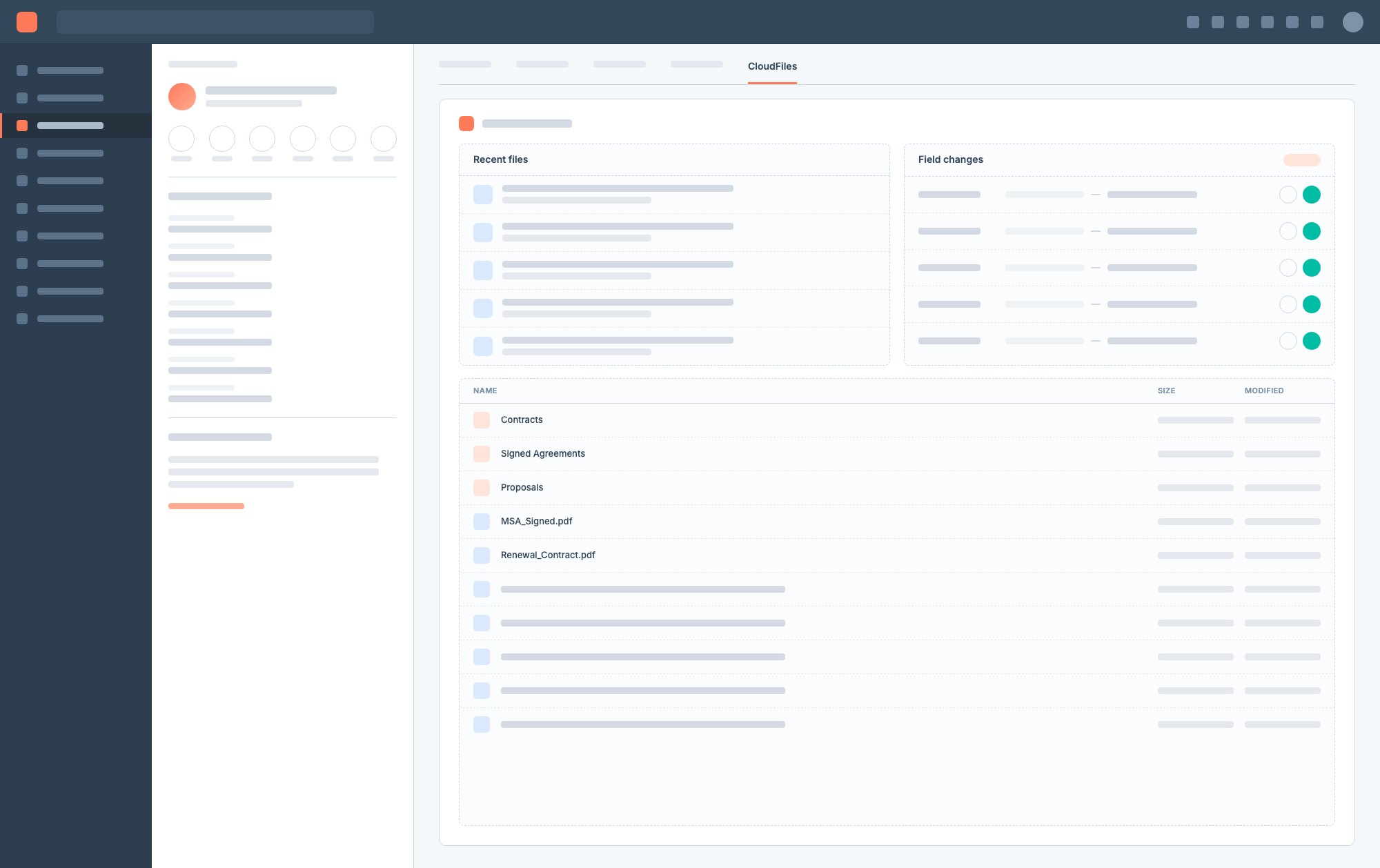
A file is a neuron, not a brain
Scattered across SharePoint, Drive, email, Slack, your CRM, even local drives, one file alone is just a blob: no status, no owner, no connections. CloudFiles wires everything you feed it into a knowledge graph, and surfaces it on the record itself: recent files, proposed updates, the whole document trail, without a separate tab to remember to check.
Illustrative mockup, not a live product screenshot.
Four steps, no migration
Your files stay exactly where they are.
Install where you work
Add it to HubSpot, or wherever your team already spends its day. No new tab to remember.
Connect your repositories
SharePoint, Google Drive, email, Slack, your CRM, even local folders. Nothing moves, nothing gets copied out.
Describe how you work
Tell it what you want to see: recently modified files, everything tied to a record, a manager's view across the team. It maps that to fields, statuses and views.
Work, and it learns
Approve or correct what it proposes. The more people use it, the better it gets, and that feedback flows straight back into the app.
What it looks like, on the record
A file manager, a recent files box, a list of field update approvals, our Document AI can look like what you want it to be.
A view of all your files, across all apps
See every file tied to the record in one place: folders and documents together, organized automatically as they arrive from SharePoint, Google Drive, email, or wherever else they live.
Illustrative mockup, not a live product screenshot.
Every file's version & path history
Track which version is current, where a file has been, and what changed along the way, all on the record, without digging through folders or hunting for the latest copy.
Illustrative mockup, not a live product screenshot.
The data mismatch with your CRM
When a file disagrees with the record, a title, a phone number, a renewal date, Document AI flags it and proposes the fix. You approve or reject; nothing writes itself.
Illustrative mockup, not a live product screenshot.
A UI that fits your use-case
Tell it what matters to your team: a manager's view, a compliance checklist, a renewal tracker. Document AI maps your files to it, no configuration or engineering work required from you.
Illustrative mockup, not a live product screenshot.
A memory built for how you work
Every file it finds becomes part of the record's memory. What that memory does next depends on what it's built from.
The memory of a deal
Contracts, proposals, one-pagers and marketing collateral: every file that touches a deal becomes part of its memory, tied to the record it belongs to.
- Renewal alarms: a contract nearing its end date surfaces automatically, before it lapses.
- Only the live version surfaces: the current proposal on top, old drafts filed away, not buried in a flat folder.
- Archived, not deleted: signed and superseded documents move to their own record, out of the way but never lost.
The memory of an applicant
Applications, income documents, ID and correspondence: every file an applicant sends becomes part of their record's memory.
- Mismatch alarms: a document that disagrees with the record, an income figure, a stage, gets flagged, not silently trusted.
- Only current documents surface: the latest ID and income proof on top, expired versions out of view.
- Archived appropriately: closed and denied applications move to their own file, not cluttering active pipelines.
The memory of a property
Listing documents, inspections, disclosures and closing paperwork: every file tied to a transaction becomes part of its memory.
- Deadline alarms: an inspection window or closing date surfaces automatically, before it's missed.
- Only live listings surface: the current MLS sheet on top, outdated versions filed away.
- Archived once closed: a completed transaction's documents move to storage automatically, no manual cleanup.
Grab the early bird offer
Find this interesting? Tell us more. Fill out the form below and we'll send you a Blueprint, regular development updates and up to 50% off at launch.
What your Blueprint looks like
A worked example: a property management team connects SharePoint. Every transaction folder becomes a record, with status moving as the deal progresses, visible right on the HubSpot deal it's tied to.
Knowledge graph map
How your files connect into records, fields and statuses.
Mock screens
What the record view looks like for your team, before anything is built.
Rollout plan
What ships first, and what to expect at each step.
A closer look at Document AI in HubSpot
Recent files, proposed updates and the full document trail, together on the record. This is the concept your Blueprint would be built around.
Get your Document AI Blueprint
We'll send back a personalized Blueprint within five days.
- Report: a written Blueprint.
- Reader: a person, not a bot.
- Call: only if you ask for one.

Your files never leave SharePoint or Drive
Files stay in your own SharePoint or Google Drive. What syncs to HubSpot is structure, not the file itself.
No. Every proposed update is a suggestion you approve or reject inside HubSpot. Nothing writes back on its own.
No. Files stay in your library. HubSpot gets the record: status, fields and a link back to the file.
Whatever permissions you've already set in SharePoint or Drive still apply. Nothing is opened up.
Right now, records sync from your library into HubSpot. Writing back to your library is the direction we're building toward, not something shipping yet.
We've been busy building and haven't priced this yet. It might be per user, or per action, we don't know. But one thing's for sure. Early registrants get up to 50% off.