

At CloudFiles, we work closely with people across the Salesforce ecosystem - architects, admins, consultants, partners, and builders who shape how technology is actually used on the ground.
Person in Focus is our way of celebrating these people. It’s about slowing down to highlight their journeys, learn from their perspectives, and create space for real conversations that connect the ecosystem...beyond roles, titles, or products.
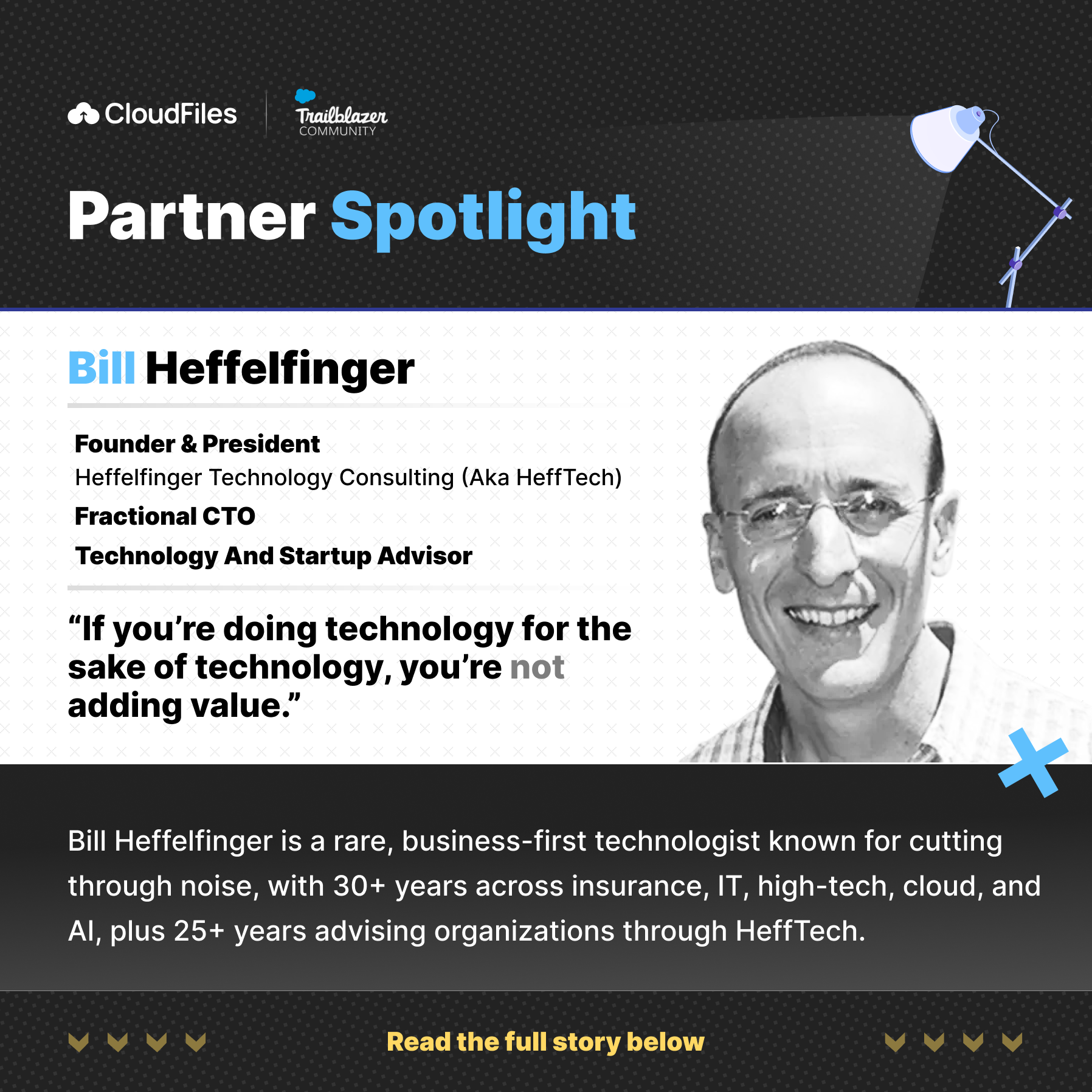
In this edition, we had the opportunity to sit down with Bill Heffelfinger - Founder & President of Heffelfinger Technology Consulting (aka HeffTech), Fractional CTO, and a Technology and Startup Advisor - with 30+ years across insurance, IT, high-tech, cloud, and AI, and 25+ years advising organizations. Bill is known for being a business-first technologist who consistently prioritizes outcomes over hype.
In our conversation, Bill unpacked the moment that made him an “accidental DBA”, why Salesforce became his go-to system for making impact measurable, and the enterprise reality many teams still underestimate - documents, retention, and the risk that quietly sits inside them.
A Career That Didn’t Start in Tech, But Was Shaped by It
Bill didn’t set out to build a career in technology. He began in insurance, even though technology had always been part of his environment. his father implemented one of the first mainframe computers in a hospital setting in Philadelphia in 1963, and Bill himself wrote his first BASIC program in 1981. Still, he chose a business path, earning a management degree and entering the insurance world.
The shift came later, and unexpectedly!
While working at a medical malpractice insurance company, Bill was part of a system rewrite when the database crashed. It was Oracle 7.4. Instead of waiting for outside help, he took the manual home, read it over the weekend, went to work Monday morning and got it running again!
As Bill told us:
“The real shift happened when I was working at a medical malpractice insurance company and we were rewriting a system. The database crashed — Oracle 7.4 — and I took the manual home, read it over the weekend, and got it back up and running. On Monday, they said, ‘Congratulations, you’re our DBA.’ I had no idea what that meant, but I loved it.”
That moment quietly redirected his career.
Learning Technology From the Inside Out
What followed was not a rush into buzzwords or trends, but years of deep, hands-on work inside IT - databases, enterprise systems, data centers, and operations. This period, Bill says, shaped how he thinks even today.
“I spent years consuming technology from the inside — which gave me strong grounding. It gave me empathy for practitioners. You understand very quickly what works in theory and what breaks in practice.”
Later, Bill moved into high-tech roles, building and leading global teams across companies like NetApp, Nimble Storage, and HPE, working at scale with enterprise customers, financial institutions, and research organizations.
He was also an early adopter of cloud, first encountering the concept in 2009, long before it became default. That early exposure, combined with his IT background, gave him a strong sense of where cloud makes sense and where it doesn’t.
Stepping Back Toward the Keyboard
At one point, Bill found himself far up the leadership ladder, and far away from the work itself. Instead of staying there, he made an unconventional decision.
“I’d moved so far up the hierarchy that I was too far away from the keyboard. I actually left a VP role to join a startup and get my hands dirty again - to prove to myself that I still had the skills and to refresh my understanding of where technology really was.”
That decision eventually led Bill into fractional CTO and advisory roles, where he could apply decades of experience while staying close to execution. Today, through HeffTech and his role at EXL Digital, he helps organizations balance innovation with responsibility, and experimentation with discipline.
His guiding belief is simple: “If you’re doing technology just for the sake of technology, you’re not adding value.”
How Salesforce Entered the Picture
Bill’s entry into the Salesforce ecosystem wasn’t driven by curiosity or certifications. It was driven by necessity. At the time, his team was using a home-grown tool to track engagements. It lacked visibility and structure, and it frustrated him. When Salesforce was introduced internally around 2012, Bill immediately pushed to get his team on it, even though they were a global overlay team and not commission-based.
His goal was clear: quantify impact. He wanted to track deal win influence, understand win and loss outcomes, and tell a credible business story upstream. Once Salesforce became the system of record, the results spoke for themselves. After adoption, Bill’s team demonstrated an 80 percent deal win influence rate on the opportunities they touched.
For Bill, Salesforce worked because it created continuity across the entire lifecycle, from lead to opportunity to close to support, making impact visible rather than assumed. When asked what advice he would give to someone starting their Salesforce or cloud journey today, Bill didn’t sugarcoat it. “Change management is hard,” he said. Getting people to do things differently always is.
His takeaway was pragmatic. Understand incentive curves. Adoption follows when people clearly see value and when outcomes are tied to how tools are used. Meet people where they are, make the value obvious, and continuity does the rest.
The Reality of Documents Inside Enterprises
When the conversation turned to documents, Bill was direct. “Documents are a messy space,” he said. “A lot of companies don’t even know what they have.” From Bill’s experience working with enterprises, the challenge goes far beyond storage. Documents are ingested without structure, accumulate over time, and are rarely revisited with intent. What concerned him most wasn’t theoretical risk - it was practical risk.
As he put it plainly: “Risk sits in those documents.” Many organizations carry years of data without clear ownership, retention rules, or accountability. And in environments where documents are tightly connected to systems like CRM, this lack of clarity quietly becomes expensive, and dangerous.
For Bill, this isn’t a tooling problem. It’s a clarity problem.
Why CloudFiles Stood Out
Before working with CloudFiles, Bill evaluated several solutions in the ecosystem. He came across many options, but most did not quite fit what he was looking for. The turning point came when CloudFiles was recommended to him by a trusted technology partner.
What stood out immediately was how easy it was to get started. There was no heavy setup or long onboarding process. As Bill put it, “You made it simple to plug and play. The on-ramp time is almost nothing.” Adoption happened quickly, and once teams began using it, they started discovering additional use cases on their own.
For Bill, CloudFiles felt thoughtfully designed. It was simple, elegant, and well considered. Rather than working against the platform it was built on, CloudFiles worked with it. Being focused on documents and doing that one thing well was not a limitation in his view. It was exactly what made the solution effective.
Beyond Work: Giving Back
Beyond his work in technology, Bill’s perspective is strongly shaped by gratitude and a sense of responsibility to give back. Travel plays an important role in his life, not just as a hobby, but as a way to learn. Exploring different cultures, languages, and food has helped him better understand the world beyond his own experiences.
That same outlook extends to the causes Bill chooses to support. He is deeply committed to projects that create long-term impact, including the Crazy Horse Memorial and University. He is also passionate about wildlife protection, particularly efforts that support rescued and endangered exotic cats.
When we asked why, his answer was simple and honest: “Animals don’t have a voice. Someone has to speak for them.” For Bill, it’s a way of giving back - a reflection of gratitude for the opportunities he’s had and a reminder that impact doesn’t always come from the work you do, but from the responsibility you take on.
Our conversation with Bill Heffelfinger was thoughtful, grounded, and refreshingly candid - shaped by decades of experience and a consistent belief in clarity over noise.
We’re grateful he took the time to share his journey with us.
If you know someone in the Salesforce ecosystem - an architect, admin, consultant, partner, or leader - whose story deserves to be highlighted, we’d love to hear from you. You’re also welcome to nominate yourself.
The spotlight is open. ⭐